
Why Taro Motorcycles Are Becoming a New Choice for Riders in Bangladesh
A few years ago, buying a motorcycle in Bangladesh was a fairly predictable decision. You picked a brand your neighbor trusted, checked the mileage figure, and went with whatever was easiest to service. That is still true for a large part of the market. But something has shifted in the last couple of years, especially among younger riders and city commuters who want their bike to say something about them, not just get them from point A to point B.
Industry data backs this up. Bangladesh's motorcycle market grew close to 20 percent in 2025 after two years of decline, and higher-capacity motorcycles above 165cc, which barely existed before 2023, sold more than 30,000 units in a single year, according to The Business Standard. Even during the tougher years of 2024, when overall sales hit a six-year low, the premium segment kept growing while everything else slowed down, as The Daily Star reported at the time.
Into that shift steps Taro, a motorcycle brand built around Italian design language and brought to Bangladeshi roads by Taro Bangla, a concern of Sikder Industry. Taro is not trying to be the cheapest bike on the road or the most familiar name in the showroom. It is trying to be the one that looks different, rides with more character, and feels like it was designed by someone who actually cares about the shape of a fuel tank or the line of a headlamp. That is a fairly new pitch in this market, and it is worth understanding why it is starting to land.
What Makes Taro Motorcycles Different?
Ask most people what separates one 150cc commuter from another and they will struggle to answer beyond "the sticker on the tank." Taro is deliberately trying to break that pattern, and it does so through a few consistent design choices across its lineup.
Italian design philosophy. Taro's motorcycles are shaped by Italian designers, and it shows in the details. Sharp tank lines, split-seat layouts on the sportier models, and fairings that look pulled from European racing circuits rather than adapted from a generic commuter mould. This is not badge-deep styling. It runs through the fuel tank sculpting, the headlamp clusters, and the overall stance of the bike on the road.
Modern styling that photographs well and rides well. Every current Taro model ships with a full-LED lighting setup, a digital or TFT instrument cluster, and clean bodywork that avoids the cluttered, sticker-heavy look common in the budget segment. For a generation of riders who post their bikes on Instagram before they post their exam results, this matters more than most brands want to admit.
Performance-focused engineering. Underneath the styling sits real hardware. Liquid-cooled DOHC engines, dual-channel ABS, six-speed gearboxes, and in one case a quick-shifter, are not common at this price point in Bangladesh. Taro is positioning its bikes closer to the mid-capacity performance segment than to the basic commuter shelf.
A distinctive road presence. Put a Taro Ranger or a Taro GP1 next to a typical 150cc commuter at a traffic signal, and the difference is immediate. The riding posture, the exhaust note, the silhouette, all of it reads differently. That visual and audible separation is exactly what a growing slice of Bangladeshi riders is shopping for.
Why Riders in Bangladesh Are Looking Beyond Traditional Motorcycle Brands
For close to two decades, the Bangladeshi motorcycle market has been dominated by a handful of Japanese and Indian names, and for good reason. They are reliable, affordable to service, and easy to resell. But reliability alone no longer closes every sale, especially in Dhaka, Chattogram, and other cities where the buyer base has gotten younger, more brand-aware, and more willing to pay a premium for something that feels distinct.
Demand for Unique Motorcycle Designs
Walk through any university campus parking lot in Dhaka and you will notice the same five or six silhouettes repeated over and over. That sameness is exactly what is pushing some riders to look elsewhere. A motorcycle with cafe racer styling, like the Taro Ranger 165, stands out precisely because it does not look like everything else parked around it. Riders are not just buying transport anymore. They are buying a visual identity they can live with every day.
Growing Interest in Premium Bikes
The appetite for premium motorcycles in Bangladesh is not a theory, it is showing up in the sales numbers. Even in a year when overall motorcycle sales fell, the premium and higher-capacity segment kept climbing, a trend both The Daily Star and The Business Standard have tracked closely. Riders with steady income, particularly in urban centers, are increasingly comfortable spending more for a bike that offers better build quality, stronger braking systems, and a more refined ride, rather than settling for the cheapest option on the lot.
Performance and Style in One Motorcycle
The old assumption in this market was that you had to choose between a bike that looked good and a bike that performed well, since the two rarely came together below a certain price. Taro's lineup is built specifically to challenge that trade-off, pairing full-fairing sportbike design with liquid-cooled engines, dual-channel ABS, and, in the GP1 Version 4, a quick-shifter that most commuter-focused brands do not even offer at double the price.
Taro Motorcycles Available in Bangladesh
Taro currently offers four models in Bangladesh, spread across cafe racer, scooter, and full sports categories. You can browse the complete, updated lineup on the Our Bike page, but here is a closer look at each one.
Taro Ranger 165
The Ranger is Taro's answer to the growing cafe racer crowd in Bangladesh, a segment that barely had any local options a few years back. It runs a 164.9cc, single-cylinder, liquid-cooled DOHC engine producing 21.5 BHP at 8,500 rpm and 18 Nm of torque, paired with a six-speed manual gearbox.
What sets the Ranger apart from a typical commuter is the hardware most brands skip at this price. Dual-channel ABS, a 5-inch TFT display, LED lighting with daytime running lamps, and dual disc brakes up front all come standard. The riding posture leans forward slightly, the tank is sculpted rather than boxy, and the overall stance sits closer to a lightweight European roadster than a mass-market commuter.
Riders drawn to the Ranger tend to want a bike that photographs well parked outside a coffee shop and still holds its own on the highway. Full specifications are listed on the Taro Ranger 165 model page.
Taro Grand Imola ADV 165
Not every rider wants a manual gearbox and an aggressive seating position, and the Grand Imola ADV 165 is built for that other half of the market. It uses the same 164.9cc liquid-cooled engine as the Ranger, but pairs it with a fully automatic CVT and belt drive, along with an auto push silent start system that makes it noticeably easier to live with in stop-and-go city traffic.
Where this model earns its "ADV" badge is in the details built for daily urban riding: a larger 7-inch TFT display, dual-channel ABS with traction control, a 10.5-litre fuel tank, and a relatively light 145 kg kerb weight. For riders navigating Dhaka's traffic, running errands, or commuting to work without wanting to deal with clutch and gear shifts, this scooter offers real performance credentials without the manual learning curve. More details are on the Grand Imola ADV 165 page.
Taro GP2
The GP2 sits in Taro's sports category and is built around a 165cc EFI engine with styling clearly influenced by full-fairing racing machines. It shares the brand's design language of sharp bodywork, aggressive lighting, and a compact, performance-oriented stance, aimed at riders who want a sportbike look without stepping up to the larger 250cc GP1.
For riders who want the visual drama of a full-faired sportbike but are working with a tighter budget or a preference for a lighter, easier-to-manage machine, the GP2 fills that gap in Taro's range. You can check current availability and updated specifications on the Taro GP2 model page.
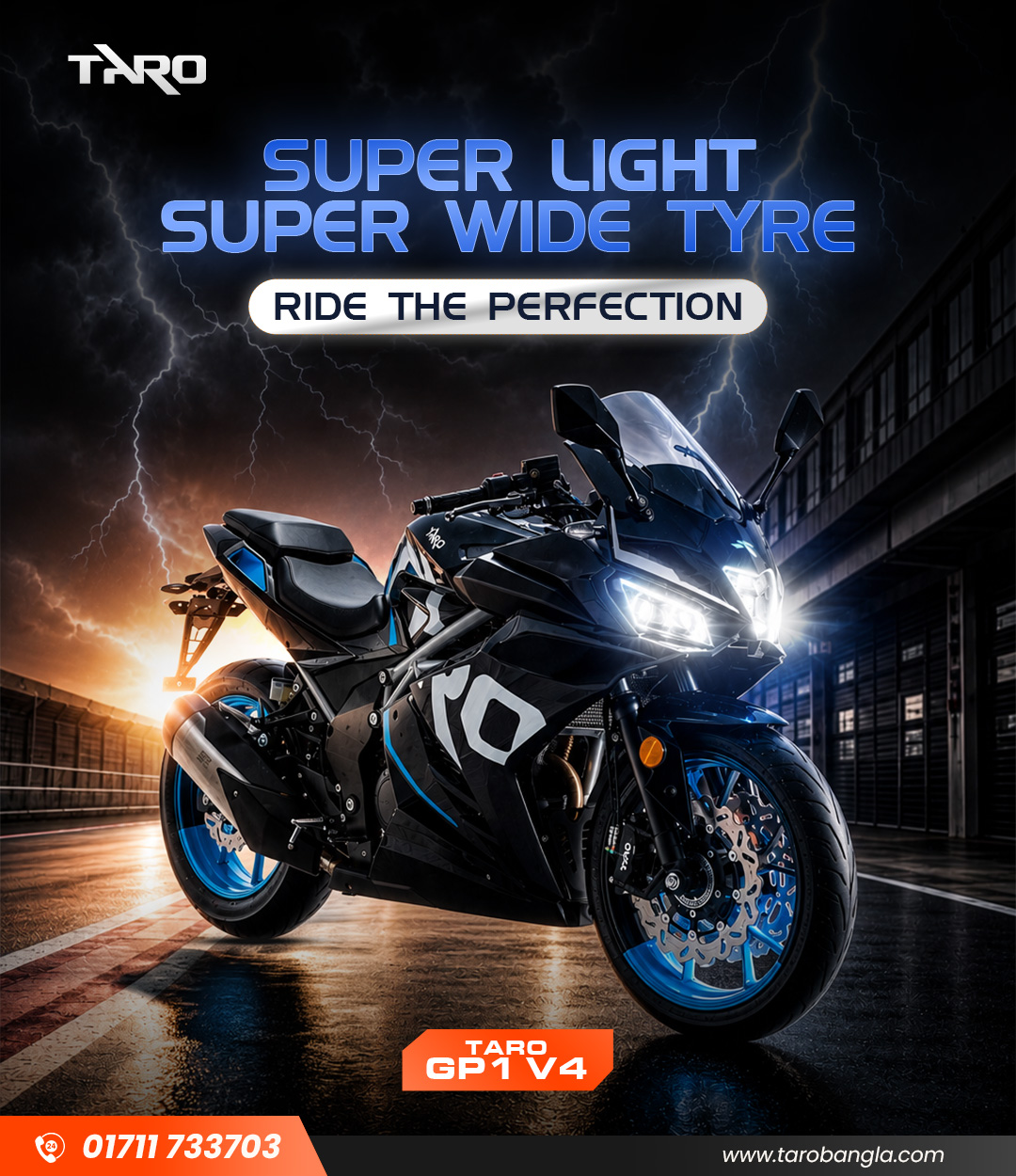
Taro GP1 Version 4
The GP1 Version 4 is Taro's flagship and the clearest statement of intent in the lineup. It runs a 249.8cc, single-cylinder, liquid-cooled DOHC engine producing 25.8 BHP at 9,000 rpm and 21 Nm of torque, mated to a six-speed manual gearbox with a quick-shifter, a feature you rarely see below the premium 300cc-plus bracket in Bangladesh.
The bike wears a full-fairing body with dual-LED headlamps and DRLs, a split-seat configuration, and a steel truss frame. Suspension duties are handled by USD front forks and an adjustable rear mono-shock, while braking comes from a dual-disc front setup with dual-channel ABS. At 800mm, the seat height and overall riding triangle are built for committed sport riders rather than casual commuters. Full specifications are available on the Taro GP1 Version 4 page.
Quick comparison of the current Taro lineup
|
Model |
Category |
Engine |
Power |
Gearbox |
ABS |
|---|---|---|---|---|---|
|
Taro Ranger 165 |
Cafe Racer |
164.9cc, liquid-cooled DOHC |
21.5 BHP |
6-speed manual |
Dual-channel |
|
Taro Grand Imola ADV 165 |
Scooter |
164.9cc, liquid-cooled |
13.5 kW |
Automatic CVT |
Dual-channel with TCS |
|
Taro GP2 |
Sports |
165cc, EFI |
On request |
On request |
Available |
|
Taro GP1 Version 4 |
Sports |
249.8cc, liquid-cooled DOHC |
25.8 BHP |
6-speed manual with quick-shifter |
Dual-channel |
Pricing for each model is available on request through the Contact Us page, and genuine spare parts support is handled directly through Taro Bangla's spare parts service.
Why Taro Is Building a Distinct Motorcycle Identity in Bangladesh
Taro Bangla was founded in 2017 as a concern of Sikder Industry, with a clear goal of bringing Italian-designed motorcycles into a market that had, until then, been shaped almost entirely by Japanese and Indian manufacturers, as outlined on the brand's About Us page. That timing lines up closely with a broader structural shift in the industry. A decade ago, Bangladesh imported nearly all of its motorcycles fully built. Today, local assembly and manufacturing supply close to 99 percent of the bikes on the country's roads, a shift documented by The Business Standard.
Taro has positioned itself inside that shift rather than against it, assembling and importing its lineup locally while keeping the design and engineering rooted in Italian motorcycling tradition. It is a fairly specific bet: that Bangladeshi riders no longer just want an affordable bike, some of them want one with a story and a design pedigree behind it. Backed by Sikder Industry's manufacturing base, Taro is trying to build that identity through consistency across its models rather than a single flagship launch.
Who Should Consider a Taro Motorcycle?
Taro is not trying to be everyone's first motorcycle, and that is by design. A few rider types tend to get the most out of what the brand offers.
-
Urban riders who deal with daily traffic in Dhaka or Chattogram and want a bike that is easy to filter through congestion but still feels premium at a standstill, particularly a fit for the automatic Grand Imola ADV 165.
-
Style-conscious riders who care as much about how a bike looks parked outside a restaurant as how it performs on the road, a natural fit for the Ranger 165's cafe racer stance.
-
Motorcycle enthusiasts who already understand the difference between a basic single-disc setup and a proper dual-channel ABS system, and who are willing to pay for the difference.
-
Riders looking for something different from the five or six familiar silhouettes that dominate most Bangladeshi streets, and who want their bike to be a genuine conversation starter.
If none of that sounds like a strong match, a standard commuter from an established brand will likely still serve you better, and that is a perfectly reasonable choice too.
The Future of Taro Motorcycles in Bangladesh
The broader market backdrop suggests Taro's timing is not accidental. Bangladesh's premium and higher-capacity motorcycle segment kept growing even through a year when the wider market shrank, and that pattern held again in 2025 as overall sales rebounded close to 20 percent, per The Business Standard's reporting. As disposable income among urban professionals continues to recover and riders increasingly research bikes online before ever visiting a showroom, brands with a clear design identity, rather than just a low price tag, stand to gain the most ground.
Whether Taro becomes a mainstream name or stays a niche pick for design-conscious riders will depend on how consistently it expands its lineup, its service network, and its parts availability across the country. But the early signals, four distinct models spanning cafe racer, scooter, and sports categories in just a few years, suggest the brand is not treating Bangladesh as a side market. It is building toward something more permanent here.
Final Thoughts
Bangladesh's motorcycle market is still dominated by familiar names, and that is unlikely to change overnight. But the space for something different, a bike that looks like it was actually designed rather than assembled, has clearly opened up. Taro is one of the few brands trying to fill it with Italian styling, real performance hardware, and a lineup that spans commuting, touring, and outright sport riding.
If you have been scrolling through the same handful of bikes for months without finding one that feels like "the one," it might be worth taking a closer look at what Taro has built.
Explore the Taro motorcycle lineup and discover a motorcycle designed around style, performance, and individuality. Visit Our Bikes to see the full range, or reach out through Contact Us to book a test ride.